e-TEP Listening Module: Free Listening Practice with Audio (PDF)
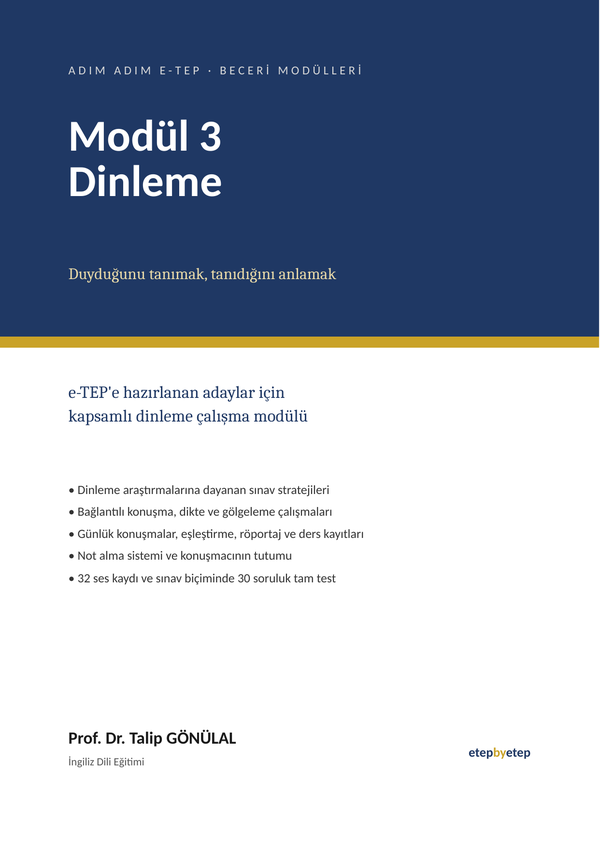
Can't recognize words you know when you hear them? This module trains your ear first, with connected speech, weak forms, dictation and shadowing. Then it covers every recording type in the exam: everyday conversations, speaker matching, interviews, long lectures and note-taking. It ends with a full 30-question practice test.
69 pages, PDF, 32 audio tracks with transcripts and an answer key. Explanations in Turkish.
Download Module 3 (free PDF) Audio tracksThis is Module 3 of the free Adım Adım e-TEP skill modules. Each module goes deeper into one skill than the study guide, with new examples and exercises.
Contents
- Listening and the e-TEP: How the listening part works and why listening feels harder than reading.
- Connected speech: Stress, rhythm, weak forms and how words join together.
- Dictation, dictogloss and shadowing: Three exercises that train your ear.
- Everyday conversations: Short conversations, changes of mind and numbers.
- Speaker matching: Matching what several speakers say to the right statements.
- Interviews and the speaker's attitude: Opinions, hesitation and attitude.
- Long recordings and note-taking: Lectures, signal phrases and a note-taking system.
- Listening outside the exam: Podcasts and a weekly listening plan.
- Full practice test: A 30-question listening test in the exam format.
At the end: an appendix with transcripts or texts and a full answer key.
Preview: weak forms
English is stress-timed: content words are clear, while small function words are shortened, often to a schwa /ə/. If you don't recognize these weak forms, you miss the structure of the sentence, for example its tense or whether it is negative.
| Word | Weak form | Example |
|---|---|---|
| to | /tə/ | I want to go. → "I want tə go" |
| for | /fə/ | It's for you. → "It's fə you" |
| of | /əv/, /ə/ | a cup of tea → "a cuppə tea" |
| and | /ən/, /n/ | salt and pepper → "salt n pepper" |
| can | /kən/ | I can swim. → "I kən swim" |
| was | /wəz/ | She was late. → "She wəz late" |
| them | /ðəm/ | Tell them. → "Tell 'em" |
Can or can't? Positive can is short and the verb after it is stressed ("I kən COME"). Negative can't is stressed and long, even when the final /t/ is not heard ("I CAN'T come").
All 32 tracks of the module are free on the module audio page.
How to use the module with the site
After each chapter, solve one of the 20 listening sets in study mode. Near the exam, take the full practice tests with real timing.
Other modules
- Module 1: Vocabulary
- Module 2: Reading
- Module 4: Speaking
- Module 5: Writing
- Adım Adım e-TEP: the study guide

All questions are original and follow the official e-TEP format.