e-TEP Reading Strategies: Free Reading Module (PDF)
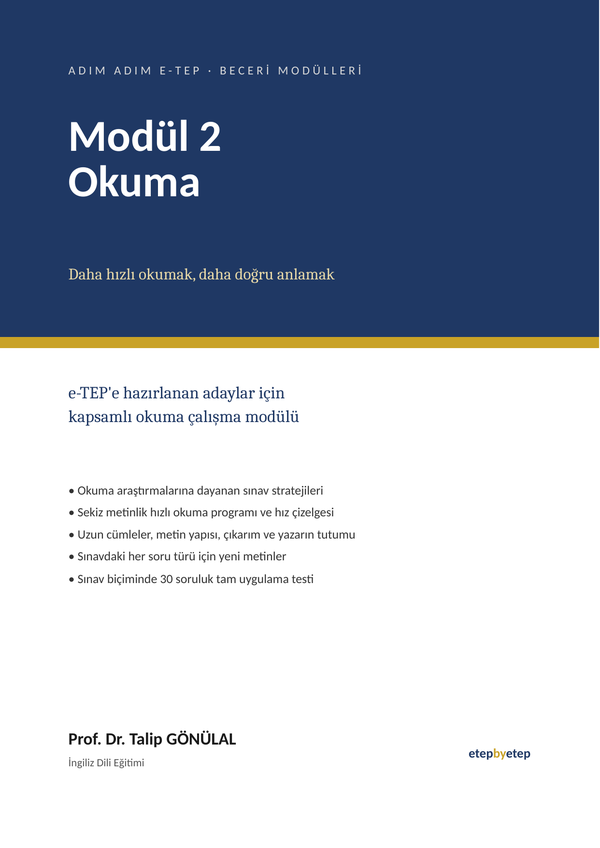
Running out of time, getting lost in long sentences, or understanding the text but still choosing the wrong option? This module works on all three: an eight-text timed reading program, long sentences, text structure, skimming and scanning, distractor analysis, inference and the writer's attitude. It ends with a full 30-question practice test in the exam format.
65 pages, PDF, 25+ new texts and 220+ exercise items with an answer key. Explanations in Turkish.
Download Module 2 (free PDF)This is Module 2 of the free Adım Adım e-TEP skill modules. Each module goes deeper into one skill than the study guide, with new examples and exercises.
Contents
- Reading and the e-TEP: The five sections of the reading part, the question types and a time plan.
- Reading speed and fluency: An eight-text timed reading program.
- Long and complex sentences: Finding the subject and verb, relative clauses and reference words.
- Text structure and cohesion: Clues for paragraph matching and text completion.
- Skimming and scanning: Finding the main idea and specific information quickly.
- Multiple-choice question types: Seven question types and the six most common distractors.
- Inference and the writer's attitude: Understanding what the text does not say directly.
- Reading outside the exam: Sources and a plan for extensive reading.
- Full practice test: A 30-question reading test in the exam format.
At the end: an appendix with transcripts or texts and a full answer key.
Preview: six common distractors
Wrong options are not written at random. They are designed to attract a test-taker who reads too fast. Chapter 6 teaches you to recognize these six traps:
| Trap | What it looks like |
|---|---|
| Word match | Uses the same words as the text, but the meaning is different or belongs to another part of the text. |
| Not in the text | Sounds sensible and may even be true in real life, but the text does not say it. |
| Opposite meaning | Says the opposite of the text, often with one small word such as not, less or never. |
| Overgeneralization | The text says some, often, may; the option says all, always, will. |
| Too narrow or too broad | In main-idea questions, fits only one paragraph or goes beyond the text. |
| Wrong cause or relation | Mentions two things from the text but links them the wrong way. |
A useful order: answer detail and vocabulary questions first, moving through the text, and leave main-idea and attitude questions to the end.
How to use the module with the site
After each chapter, solve one of the 20 reading sets in study mode. Near the exam, take the full practice tests with real timing.
Other modules
- Module 1: Vocabulary
- Module 3: Listening
- Module 4: Speaking
- Module 5: Writing
- Adım Adım e-TEP: the study guide

All questions are original and follow the official e-TEP format.